CB-Exo-A600 is now listed on ClinicalTrials.gov as a recruiting Phase 1/2 study in mild-to-moderate Alzheimer's disease.
That is the news. The useful reading is narrower: a recruiting early trial with a serious enough design to track before results exist.
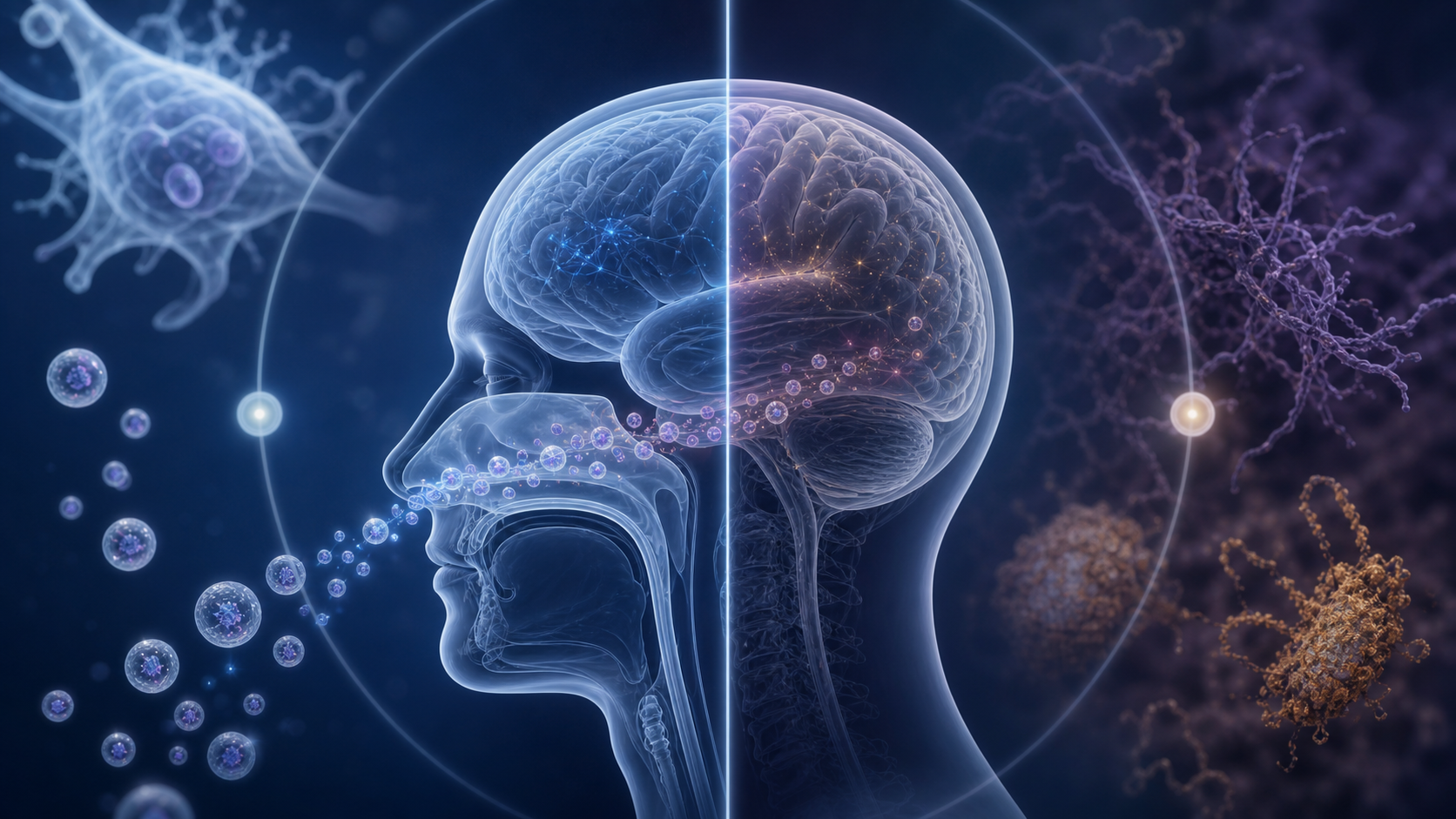
Still, it is worth reading closely, because this is the exact class of program that can either become a serious translational step or drift into mechanism-first storytelling before data exist. The registry record is more substantial than a vague cell-therapy announcement. It describes an intranasal product, exosomes derived from umbilical-cord mesenchymal stem cells, given twice weekly for 12 weeks. It also describes a two-part design: a dose-escalation phase followed by a randomized, quadruple-masked, placebo-controlled expansion cohort.
That structure deserves attention.
The dose-escalation phase uses a traditional 3+3 design across three particle concentrations: 0.75, 1.50, and 3.00 x 10^10 particles/mL. Dosing is 1 mL per nostril, 2 mL total per administration, twice weekly for 12 weeks. The expansion cohort then plans to randomize 24 participants 1:1 to exosome or placebo comparator, with the expansion dose selected by a Safety Review Committee based on the dose-escalation data. Total planned enrollment is 33.
For a field full of loosely specified exosome programs, those details carry weight. They show that the public registry is asking an actual early clinical question rather than merely decorating a mechanism story with clinical language.
The primary outcome is the incidence of serious adverse events at 24 weeks. Secondary outcomes include adverse events, severe adverse events, ADAS-cog, MMSE, MoCA, ADCS-ADL, and NPI. Exploratory or other outcomes include blood-based AD biomarkers such as A-beta 42/40, p-tau181, p-tau217, NfL, and GFAP, plus peripheral blood proteomics and RNA sequencing, hippocampal volume, and amyloid PET.
The endpoint hierarchy is the public interpretation.
Safety first. Clinical and biomarker movement second. Mechanistic interpretation only after the product, dose, exposure, and placebo-adjusted changes can be read together.
The study is not enrolling a vague dementia population. The inclusion criteria require age 50 or older, mild-to-moderate AD corresponding to clinical stage 4-5 under the 2024 NIA/AA criteria, and biomarker support through recent CSF data, amyloid PET, or plasma p-tau217 indicating brain amyloid positivity. MMSE must be 10 to 24. The registry also requires a caregiver who can support study procedures and reporting.
That makes the trial more interpretable than a broad memory-clinic study. It also raises the stakes. Alzheimer's trials are noisy even when they are well designed. Small early trials can be moved by baseline heterogeneity, learning effects, rater variability, endpoint multiplicity, caregiver effects, disease stage, and the uncomfortable fact that biomarkers and cognition do not always move together in a clean story.
So this is a good development step. It is not yet evidence of therapeutic benefit.
The preclinical context is real, but it should be kept in proportion. A 2026 Frontiers in Neurology systematic review and meta-analysis looked at human umbilical-cord MSC therapy in AD mouse models. It found directional evidence for improved spatial learning and memory and changes in amyloid burden, BDNF, and neuronal apoptosis across included animal studies. But the same full text is explicit about the cautions: low methodological quality in the primary studies, risk of effect inflation, publication bias, sex bias, and residual heterogeneity.
That is useful context for why umbilical-cord MSC approaches keep moving forward. It does not validate CB-Exo-A600.
The route-specific context is also preclinical. A 2020 Stem Cells Translational Medicine paper tested intranasal extracellular vesicles from cytokine-preconditioned bone marrow MSCs in a 3xTg Alzheimer's mouse model. The study reported that EVs reached the brain and were associated with reduced microglial activation and higher dendritic spine density. That helps explain why intranasal EV delivery remains attractive.
But it is still a mouse study. The product source differs. The vesicle preparation differs. The dose differs. The disease biology differs. A mouse brain-distribution result cannot be silently upgraded into human target engagement.
This is where public writing on exosomes often fails. "Intranasal" sounds like it solves CNS delivery. For now, it proposes a route. The registry does not yet show whether CB-Exo-A600 reaches relevant human brain compartments, changes inflammatory or amyloid biology, produces durable biomarker movement, or separates from placebo on cognition or function.
The word "exosome" also hides more than it reveals. A vesicle product is not defined only by its parent cell source. It is shaped by donor selection, cell culture conditions, stress or preconditioning state, isolation method, particle distribution, cargo profile, contaminants, storage, release criteria, potency assay, and batch consistency. For CB-Exo-A600, the registry tells us the broad source category, dose concentration, route, schedule, and trial design. Potency and reproducibility remain outside what the public registry can answer.
This is the next question the trial makes important, not a criticism of the trial.
If the study later reports a clean safety profile and a credible clinical pattern, the interpretation will not be "MSC exosomes work in Alzheimer's." It will be more specific: this product, under this manufacturing process, at this dose, by this intranasal schedule, in this biomarker-defined population, moved these outcomes relative to this comparator. Anything broader would be too far ahead of the data.
The best current reading is therefore constructive and bounded.
Yes, this is more serious than most exosome noise. A recruiting Phase 1/2 study with dose escalation, masking, a placebo-controlled expansion, biomarker-defined eligibility, and multiple clinical and biological readouts is a meaningful development step.
No, it is not evidence that intranasal umbilical-cord MSC-derived exosomes improve Alzheimer's disease.
The next step is results: tolerability, dropouts, adverse events, dose behavior, blinding integrity, placebo-adjusted cognition, daily function, biomarkers, imaging, and some credible bridge between the administered vesicles and the CNS biology being claimed. Safety can move the program forward. A scattered secondary change cannot carry the story alone.
For CellXperience, this is the right kind of MSC/exosome item to cover. A real early trial is beginning, the design is visible, and the result will be easier to interpret because the public record already tells us what is being tested.
Sources
- Primary registry source: ClinicalTrials.gov NCT07457125 - https://clinicaltrials.gov/study/NCT07457125
- Full-text context source: Frontiers in Neurology, "Human umbilical cord mesenchymal stem cells therapy for Alzheimer's disease: a systematic review and meta-analysis of mouse models" - https://www.frontiersin.org/journals/neurology/articles/10.3389/fneur.2026.1783757/full
- Full-text route-context source: Stem Cells Translational Medicine / Oxford Academic, "Intranasal delivery of mesenchymal stem cell-derived extracellular vesicles exerts immunomodulatory and neuroprotective effects in a 3xTg model of Alzheimer's disease" - https://academic.oup.com/stcltm/article/9/9/1068/6406935
- Recruiting registry record plus preclinical context; no posted human results.
- Early trial design, preclinical rationale, and eventual human efficacy remain separate questions.