
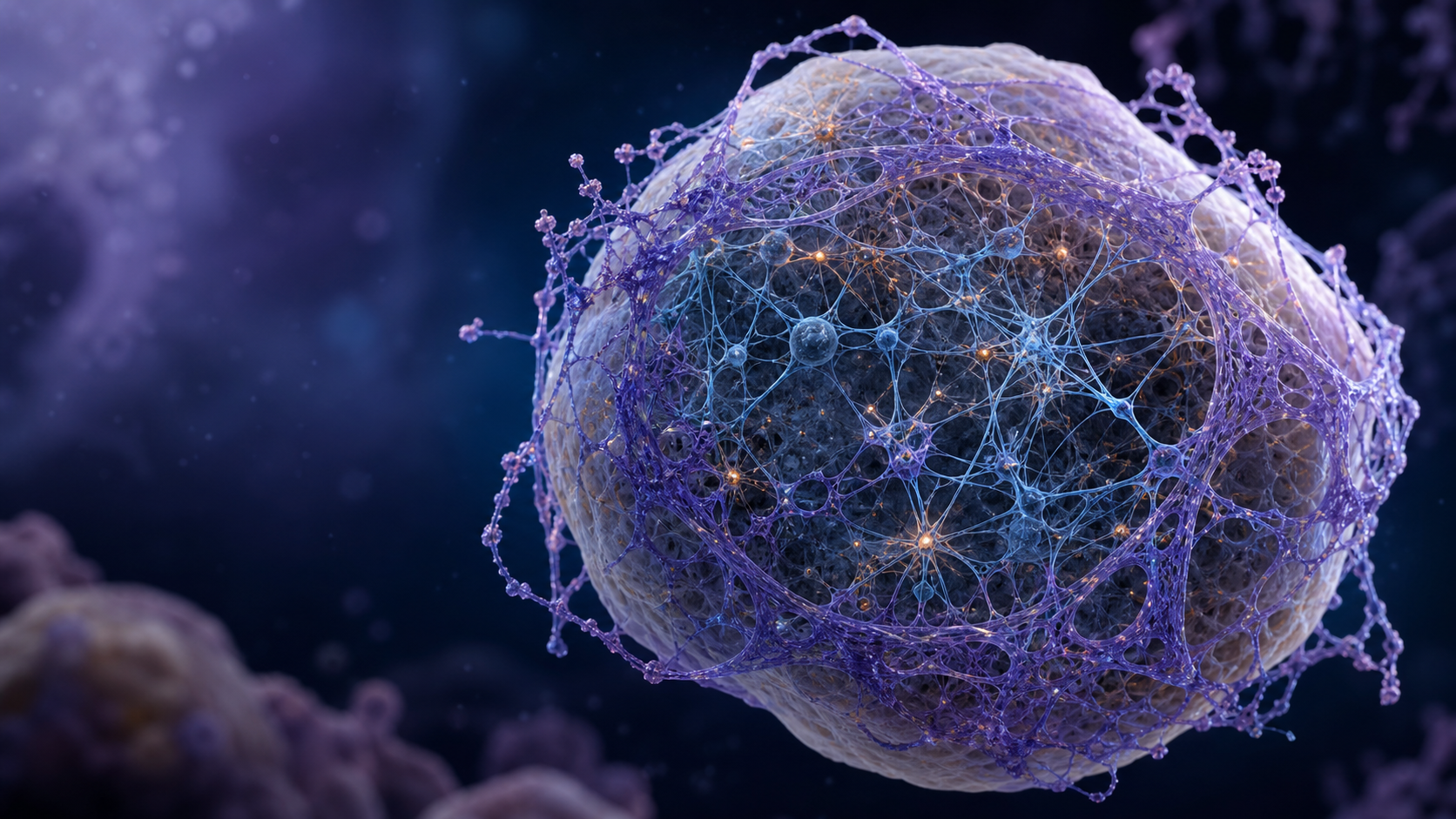
Editorial illustration of the model idea: an SNCA triplication midbrain organoid where the useful surprise sits in the extracellular architecture around neurons. Credit: CellXperience generated editorial illustration.
The odd finding is not only inside the cell
An alpha-synuclein gene-dosage paper is supposed to pull your eyes inward. Protein folding. Aggregation. Stress responses. The familiar machinery of a neuron trying to live with too much SNCA.
This one does that. But the part that feels most alive is not only inside the cell.
In a 2026 npj Parkinson's Disease study, Statoulla and colleagues used human iPSC-derived midbrain organoids carrying SNCA triplication, alongside isogenic comparator lines, to look at early synucleinopathy biology. The expected story was there: proteostasis-related signalling, protein-synthesis stress, and molecular changes that fit a system under alpha-synuclein pressure.
Then the paper turns outward. The authors report changes in extracellular matrix organization and perineuronal-net-associated structures around neurons. In other words, increased SNCA dosage did not only disturb the intracellular housework of protein handling. In this model, it also appeared to disturb the local architecture around neurons before pronounced neurodegenerative changes had taken over.
That is the strange part worth sitting with. Parkinson's disease is usually narrated through vulnerable dopaminergic neurons, misfolded alpha-synuclein, mitochondrial stress, lysosomal stress, and eventually cell loss. Those are still central. The organoid result does not replace them. It adds an uncomfortable spatial question: what if some early disease-model stress is written into the scaffolding around the cells, not just into the cells themselves?
The answer is not ready to travel very far yet. But the question is better than another flat statement that organoids model disease.
Before degeneration, in this model, means something narrow
The phrase "prior to neurodegeneration" is powerful. It is also dangerous.
In this paper, it means something specific: within the studied human midbrain organoid time course, the SNCA triplication line showed early alterations in proteostasis-related signalling and extracellular matrix organization before pronounced neurodegenerative changes. That is different from saying the same sequence has been proven in living patients with Parkinson's disease.
The distinction is not a small caveat. It is the difference between a useful model and an overgrown claim.
The study draws strength from the model design. Human iPSC-derived midbrain organoids give researchers a three-dimensional, genetically defined system where SNCA dosage can be examined in a tissue-like context. Isogenic comparison matters because the disease-linked copy-number change is not floating in an unrelated genetic background. Multi-omic profiling, ribosome profiling, and imaging then give several ways to see the system strain under that dosage.
But every one of those strengths remains inside the model. Organoids are not adult substantia nigra. They do not carry the full age, vasculature, immune history, environmental exposure, circuit state, or decades-long progression of Parkinson's disease. They can reveal a sequence of events under controlled conditions. They cannot, by themselves, declare the sequence of human disease.
That is why the extracellular-matrix result is interesting in the exact measure that it is bounded. The paper does not need to prove that extracellular remodeling is the first event in Parkinson's disease. It only needs to make a serious reader ask whether neuron-intrinsic stress and local tissue architecture are more entangled than the usual story admits.
That is already enough.
The useful part is the pressure it puts on the model
The practical value here is not a treatment claim. It is pressure on the assay.
If a midbrain organoid model of SNCA triplication can show proteostasis stress, translational buffering, and extracellular architecture changes before obvious degeneration, then the model gives more than a late-stage injury readout. It gives a way to ask what kind of stress appears while the tissue still looks partly intact.
That matters for disease modeling. Many neurodegeneration models are strongest when damage is already visible. Cells are gone. Markers collapse. The phenotype becomes easy to see and hard to interpret. Earlier readouts are messier, but they may be closer to the biology people actually need to understand: compensation, failed adaptation, local vulnerability, and the point where stress stops being handled.
The related 2026 SNCA triplication autophagy paper points in the same broad direction, although through a different lens: iPSC-derived neurons and midbrain organoids are being used to watch early cellular stress and clearance biology in human-relevant systems. Taken together, these papers do not make SNCA organoids clinically predictive. They make them harder to dismiss as decorative biology.
The discomfort is useful. If extracellular matrix and perineuronal-net readouts move in the same disease-model window as proteostasis stress, then future experiments have to decide whether those structures are passengers, buffers, amplifiers, or simply correlated debris. Each answer would mean something different.
The wrong move would be to skip that work and jump to target language.
What would make the strange part sturdier
The next evidence is not a press release.
The claim gets sturdier if the extracellular architecture finding holds across more lines, protocols, and laboratories. It gets sturdier if perturbation experiments can move the matrix phenotype and show what happens to neuronal stress. It gets sturdier if cell-type-specific methods separate dopaminergic vulnerability from mixed-organoid averages. It gets sturdier if patient tissue, fluid markers, or orthogonal models point toward the same direction without forcing the comparison.
Until then, the cleanest reading is also the most interesting one: this is a mechanism and platform paper, not a therapy paper.
It says that an SNCA triplication midbrain organoid can reveal early stress outside the expected intracellular frame. It does not say that extracellular matrix remodeling is a validated drug target. It does not say that a patient can be staged by this signal. It does not say that changing the matrix will change disease.
The paper is worth attention because it leaves the neuron less alone.
That is an unsettling thing for a Parkinson's model to do. Good. A model should not only confirm the story we already know how to tell.
Key Sources
- SNCA triplication disrupts proteostasis and extracellular architecture prior to neurodegeneration in human midbrain organoids
- PMC record for the SNCA triplication organoid paper
- Autophagy dysfunction in iPSCs-derived neurons and midbrain organoids carrying a SNCA triplication
- Midbrain organoids with an SNCA gene triplication model key features of synucleinopathy